
Cobra Kai Should’ve Died
On revisionist histories, legacies, and the narrative noose.
“You're gonna regret this when it's over,” said Johnny Lawrence in the first season finale of Cobra Kai (2018), sequel to The Karate Kid (1984) film franchise.
“Yeah, right,” Daniel LaRusso retorted. “Like this'll ever be over.”
I love this show. I can’t stop talking about this show. I’ve spammed thousand-words worth of messages in the group chat about this show. Across its six-season run, this one exchange keeps coming back to me as its central thesis.
Thirty-four years after his defeat at the 1984 All-Valley Under-18 Tournament, Johnny Lawrence’s life is a mess. To help his teenage neighbour Miguel Diaz stand up against bullies (and, perhaps, to relive a bit of his own adolescent glory days), Johnny resurrects the Cobra Kai dojo—and reignites that ancient feud against his karate nemesis, Daniel LaRusso.
As Lawrence and LaRusso graduate from students to sensei, their rivalry also evolves to take on a somewhat philosophical dimension. Is not just about who between Daniel and Johnny is the better karate fighter? There’s also the question of which between the defensive Miyagi-do and the offensive Cobra Kai is the better form of karate?
It’s a debate argued through leg sweeps and crane kicks. Over six seasons and three in-universe years, Cobra Kai slowly inches toward an answer.

It takes until the end of season three for Daniel and Johnny to officially unite the dojos to fight against a greater threat: Cobra Kai old guard John Kreese. Eventually, their co-sensei partnership evolves into true friendship. In parallel, Johnny’s personal life is also in ascendance: forging a father-son bond with Miguel; reconciling with his estranged son, Robby Keene; striking up a romance with Miguel’s mother, Carmen. You can track Johnny’s character development in his outfit changes: casting aside the black gi of Cobra Kai; shrugging on Eagle Fang crimson; finally donning Miyagi-do white.
So what does it mean when the final season contrives a plot device to put him back in black?
For all his progress, there’s one albatross Johnny Lawrence can’t shed, lest the whole premise of the show falls apart: the titular dojo itself.
The thorny legacy of Cobra Kai begins with Vietnam War veterans John Kreese and Terry Silver, who were trained in the Way of the Fist by Captain Turner, who, in turn, was taught during the Korean War by Master Kim Sun-Yung.
“Do you remember when we got back from ’Nam? We went through hell seeing our friends die, only to be welcomed back by hippies who called us killers. People needed to learn respect, some discipline. That's why we started Cobra Kai.” ― John Kreese to Terry Silver
Strike First. Strike Hard. No Mercy. The philosophy of Cobra Kai is “Survival of the Fittest” meets “Might Makes Right” meets a heavy dose of American military propaganda. (While neither Kreese nor Silver are presented as moral figures, the show takes great pains to provoke audience sympathy for their plights, devoting multiple flashbacks to the torture and anguish they experienced during the Vietnam War—with zero commentary on the devastation the Vietnamese peoples faced as a result of American intervention. Yeah.)
In parallel, Miyagi-do was also established in America by a veteran. But while Mr. Miyagi fought for the United States in World War II, his pregnant wife was imprisoned in Manzanar, a Japanese American internment camp, where she ultimately died due to complications in childbirth in a dire environment.
Despite the recently popularized revisionist history (looking at you, Barney Stinson), Daniel LaRusso is the titular Karate Kid, the underdog hero. The original movie paints a clear-cut good/bad dichotomy between the two dojos, the two sensei, and the two philosophies: Mr. Miyagi’s story calls out the United States’ hypocrisy in exploiting Asian immigrants to fight in American wars while their families died in American concentration camps, while John Kreese stands in opposition, running his dojo like a drill sergeant at bootcamp and propagating that militaristic, nationalist agenda.
When Johnny Lawrence reopens Cobra Kai, he also (somewhat unknowingly) reopens the can of worm that is the dojo’s toxic legacy—a fact that he comes to realize at the end of season one when his karate son, Miguel, ruthlessly injures his biological son, Robby, in order to secure a tournament win.
Yes, Johnny’s student defeated Daniel’s student, a reversal of All-Valley 1984, but at what cost? Is victory worth it, if victory looks like this?
In season two, Johnny’s struggles with his karate inheritance heightens with the reappearance of his karate father, John Kreese. For Johnny, his love/hate for Kreese is intwined in his love/hate for Cobra Kai: Here is the man (and the dojo) I idolized in my youth. Here is the man (and the dojo) who did me unimaginable harm. Here is the man (and the dojo) whose influence I cannot shed.
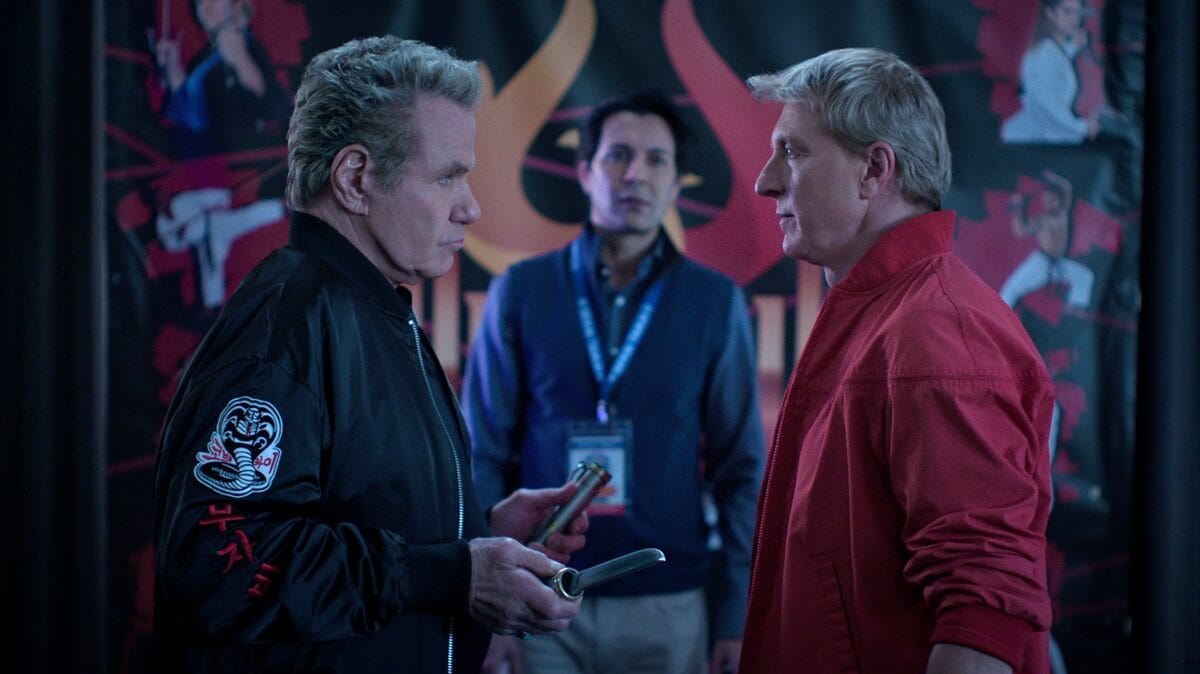
In season three, Daniel makes a trip to Okinawa, reunites with an old flame (Kumiko) and (yet another) old karate rival (Chozen), and gains deeper insights to Mr. Miyagi’s life before his death. In season four, John Kreese calls up his co-conspirator, Terry Silver. In season five, Silver tags in Kim Da-eun, Master Kim’s granddaughter and another sensei teaching the Way of the Fist.
The world of Cobra Kai is expanding. History is deepening; legacies are challenged or reaffirmed.
But Johnny just…never grapples with any of that.
Johnny’s focus, from season three onward, is primarily on his family. Though he remains a committed sensei to Eagle Fang and, later, Miyagi-do, with Miguel, Robby, Carmen, Rosa, and a new daughter, he’s building a life that’s about more than just karate—a life outside of Kreese’s influence.
At the top of season six, Johnny’s asked to reclaim Cobra Kai and take the dojo to the Sekai Taikai, an international karate tournament, since all other serpent sensei are otherwise disqualified. Turning this opportunity down, Johnny instead tells Daniel that Miyagi-do has the right to represent them on the international stage, though Johnny (and Chozen) will stay on as sensei.
The idea of Johnny reclaiming Cobra Kai is not raised again until the final episodes of season six. Though Kim Da-eun and John Kreese led a new contingent of Cobra Kai students from Korea through the Sekai Taikai, they chose not to return to the tournament following the death of their male captain, Kwon. With Miyagi-do too far behind on points, the only way to defeat Terry Silver’s Iron Dragons is for another Cobra Kai male captain to step up.
Enter: Miguel, under Johnny’s tutelage. When Miguel’s win earns Cobra Kai enough points to tie with the Iron Dragons, Sekai Taikai unveils yet another twist: their tiebreaker event, a match between the two dojos’ sensei. And so, despite the strides he made to move on from Cobra Kai, Johnny must regress back to black.
Johnny states that, come victory or loss, this time he’ll be fine because he’s got his family to support him. But in centering Johnny’s victory at the Sekai Taikai as his crowning glory, not only does it decentre and thus devalue his other (non-karate) achievements, it also reaffirms the toxic mindset that he’s owed this karmic rematch—that his loss to LaRusso in 1984 was an injustice that needed to be corrected.
An organic full circle moment can bring a sense of narrative completion; forced down the audience’s throat, however, and it feels more like a narrative noose.
Cobra Kai the show’s refusal to move away from Cobra Kai the dojo is a symptom of the show’s overall refusal to move away from karate itself.
Consider this bit in season six: Sekai Taikai host punches an All-Valley Tournament organizer, neatly resolving years of bureaucratic babbling. Whatever lip service Cobra Kai pays toward the dangers of wanton aggression, beneath it all, the very structure of a dramedy show necessitates asking what is the funniest, most dramatic, and/or most entertaining thing that can happen in any given scene. Violence, as always, is the answer.
To be fair, certain characters have actually tried to walk away from karate. In the end of season four, Miguel Diaz forfeits his place at the All-Valley Tournament after becoming disillusioned with Sensei Lawrence, fleeing to seek another source of parental validation (re: his biological father). At the start of season five, Sam LaRusso declares she wants to take a step back from karate after losing to her long-time rival, Tory Nichols, at that same tournament.
But this is the karate show, so there was never any hope that either of them would stay away from the mat for too long.
Miguel returns home after learning his biological father is no better (and in fact a lot worse) than his karate father. Sam finds her motivation to fight again after facing bullies in a bar. Heading to Barcelona for the Sekai Taikai in season six, Miguel hopes to leverage a tournament win into an acceptance at Stanford, while Sam relishes this chance to see the world beyond the Valley. It’s clear that while Sam and Miguel want the tournament win, they don’t need it. They love karate, but they’ve also got dreams beyond karate. Yet, for Cobra Kai to work, the show must continue to make karate the central focus of their lives.
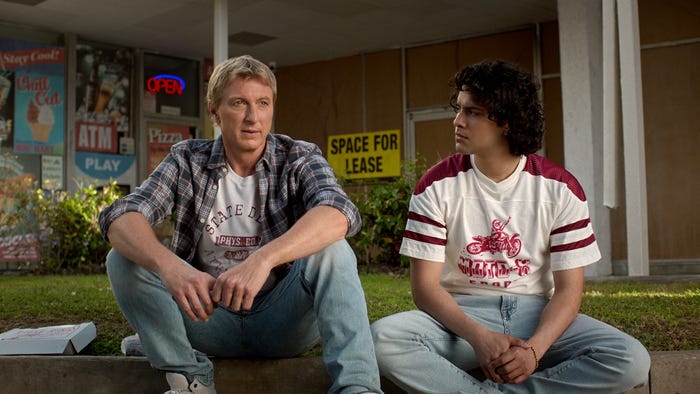
It’s only in the eleventh hour of the final season when Sam decides to withdraw from the semifinal match against her rival-turned-friend Tory Nichols, but Miguel is put back in black to fight against Axel Kovačević of the Iron Dragons—after Axel grievously injured Miyagi-do male captain Robby Keene in a previous match.
Without any college prospects like Miguel, this tournament is Robby’s only shot at a future. A seemingly invincible opponent like Axel challenges Robby’s confidence throughout season six; but All-Valley champion Miguel, on the other hand, is unshaken by Axel. In one scene, Miguel literally sees this guy glaring at him from across an atrium and goes, “What’s his problem?” In the episode immediately following Miguel’s victory, it’s revealed that he got into Stanford before he won the match, meaning that his win is not so meaningful after all.
Again and again, we see that karate no longer needs to be the centre of Miguel and Sam’s worlds—but neither can be given too much time and space to explore themselves outside of it, not in this karate show, not until the very end.
But if there’s one character whose life revolves around both karate and Cobra Kai in a way that makes sense, it’s Tory Nichols.
With a sick mom, a baby brother to raise, and a hell of a temper, Tory has always been typecast as the Bad Girl—the pauper to Sam’s princess. It’s why Zara, female captain to the Iron Dragons and Tory’s season six rival, gets under her skin. Not only did Zara sexually assault Tory’s ex, Robby, while he was incomprehensibly drunk (yikes), she’s also a social media darling, a lean mean PR Machine, as beloved as Tory is vilified. This echoes Tory’s previous rivalry with Sam:
“The world shows no mercy. So why should we? Some people have it good, but the rest of us, we have to fight for every inch of what’s ours. Not just to score a point. For everything.” — Tory Nichols
Like Johnny, Tory’s got a chip on her shoulder about those who “have it good.” Everyone loves this person, but only I know they’re a real asshole. Like Johnny, Tory’s indignation and aggression draws her toward Cobra Kai and John Kreese’s mentorship.
Queen Cobra finally joins Miyagi-do at the start of season six, though her tenure lasts but a few episodes. Tory returns to Cobra Kai after her mom’s death, seeing it as her only chance to be a female captain at the Sekai Taikai. Johnny is understanding of why Tory must fight to work through her grief; Sam tells Tory to “own her choice.” Cobra Kai never lets Tory off the hook for her transgressions because of a sob story, but the show’s also quite sympathetic about why Tory seeks ruthlessness.
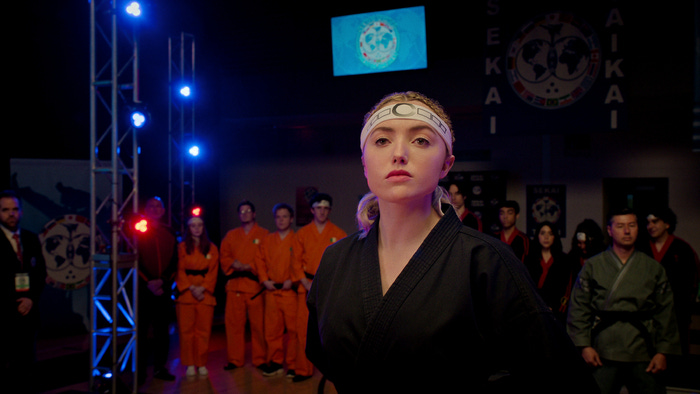
Tory’s final match against Zara is not just a battle of wills; it’s also a battle for self-worth. In victory (and in acquiring a brand deal for her and her boyfriend, Robby), not does Tory prove herself a winner—she also declares to the world that someone with her struggles, her flaws, and her humble beginnings can become someone esteemed, beloved, and worthy.
Her arc is one among many in Cobra Kai that shows how karate can be a positive emotional outlet, transforming fear into power, anger into action.
Should Cobra Kai—the dojo, the philosophy, the idea—die?
The militaristic aggression John Kreese and Terry Silver instills in their students is unambiguously corruptive, but is there anything salvageable about Strike First, Strike Hard, No Mercy?
If so, who has the right to do the salvaging? To reclaim and repair that legacy?
Here’s the other thing: Cobra Kai never fully grapples with the implications of making two white men the authority on teaching an East Asian martial art to a group of predominantly white teenagers. (Quite frankly, the show’s treatment of its characters of colour is quite thoughtless. See: Axel is the only season six rival to be portrayed with any sympathy, while Kwon and Zara are reduced to one-dimensional villains.)
Instead, the show toes that thin line between cultural appropriation and cultural appreciation. Many of our white leads have deep, personal histories with Asian karate masters (Daniel with Mr. Miyagi and Chozen; Kreese and Silver with Master Kim and Da-eun), which gives them a touchpoint to karate’s cultural history. Johnny, however, never meaningfully reflects on Cobra Kai’s Korean roots. It’s Tory who is briefly mentored by Da-eun in season five, though, frustratingly, they aren’t given a proper goodbye (neither do Tory and her season five mentee, Devon Lee). How strange is it that Johnny and Da-eun—the two Cobra Kai sensei left standing—never even acknowledge each other in the series finale?
Furthermore, Johnny never reckons with the fact that Kreese and Silver established Cobra Kai to push American military propaganda. Johnny’s struggles with the dojo’s legacy starts and ends at his personal relationship with John Kreese. While Kreese and Mr. Miyagi are diametrically opposed because of their conflicting perspectives on war, by Johnny’s feud with Daniel is sometimes watered down to what’s the best way to stand up to schoolyard bullies?
Perhaps its a moot point to discuss whether Cobra Kai should die. Cobra Kai can’t die, not until the show dies. But though the finale implies a continued co-existence between Cobra Kai and Miyagi-do beyond the show’s run, it leaves incomplete and inadequate answers to the next central question: How should Cobra Kai live on?